Yep, that's why I said it was linked with the wing:
It's like this / before the wing, and like that \ after it. I think the room wich takes the wing is linked with the guter position (in the same direction as the wind).
It's not linked with the wing but with the flow over the fuselage. Well ok some part of the flow is linked with the wing but that's not what I want to hear. even if there was no wing the inclination would have been the same.
Think about the air flowing around the fuselage and what people need to optimize when they design non lift generating parts of airplanes !!!
When once you have tasted flight, you will forever walk the earth with your eyes turned skyward, for there you have been, and there you will always long to return."
The rails are indeed inclined in a way to decrease drag. To be exact they are aligned with the local flow lines along the fuselage. This will enable to have minimum drag. Since the fuselage is a non lift device the optimisation is to reduce drag the most and not to create lift. This is also obtained by avoiding regions with supervelocities. Supersonic speed namely creates a shokwave and therefore a lot of drag.
Between which two frequencies are we talking about VHF ( Very High Frequency )?
When once you have tasted flight, you will forever walk the earth with your eyes turned skyward, for there you have been, and there you will always long to return."
When once you have tasted flight, you will forever walk the earth with your eyes turned skyward, for there you have been, and there you will always long to return."
Ok since nobody came up with the right answer I'll ask an easier question.
First of all the answer to my previous question:
In the "basic six" we have: Airspeed Indicator; Gyro Horizon; Vertical speed indicator; Altimeter; Direction Indicator and the Turn and Bank Indicator.
The ones working with a Gyro are: Gyro Horizon; Direction indicator (can also work with a magnetic compass); Turn and Bank Indicator. Those three instruments provide the information of the aircraft's attitude.
Now my next question: What does GDOP mean ? and briefly explain the what it is
It's a system that determines which is the best sattelite to use from your current possition and what would be a bad selected sattelite to contact.
Is used in GPS.
GDOP is correct Andries BUT the definition is not really that ... .
Navigation systems have a certain accuracy which of course isn't 100%. So in fact you don't know the exact location of your plane. You are given a small area and within that area you are situated with your plane. Now when you move (flying) your relative position will change with respect to the beacons on the ground (VOR, DME etc.. or in the space GPS). By changing the "geometry" of the problem the area where you are located varies. Which means that the precision changes as well.
To make a long story short, GDOP tells us that the precision of your navigation device you are using is also dependend on your relative position to the beacons. Whether those are GPS or VOR, DME etc...

 But it shouldn't be that difficult.
 . Could it be linked with the wing?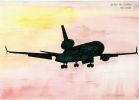


 Andries